




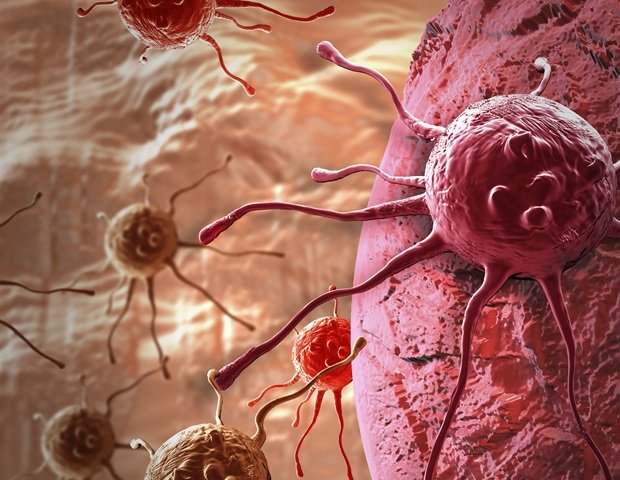
Printed in Nature Most cancers: Researchers on the Université libre de Bruxelles (ULB) have found that immune cells construct distinct “neighborhoods” round most cancers cells. In considered one of these neighborhoods, immune cells talk with most cancers cells to advertise their means to unfold to distant organs and mediate metastasis formation. This analysis may finally assist develop new therapies to focus on metastasis.
Most most cancers deaths should not brought on by the unique tumor, however by metastases, which correspond to the most cancers cells that go away the unique tumor and disseminate to different organs. To take action, most cancers cells should loosen their attachment with the opposite most cancers cells and change into extra motile, to have the ability to transfer away from the tumors, a course of referred to as epithelial-to-mesenchymal transition, or EMT. EMT is a progressive phenomenon and most cancers cells undergo an intermediate “hybrid” stage, which is the very best at forming metastases.
The research, revealed within the prestigious journal Nature Most cancers, was led by Prof. Cédric Blanpain, MD/PhD, investigator on the WEL Analysis Institute, director of the Laboratory of Stem Cells and Most cancers and professor on the Université libre de Bruxelles.
The most cancers is product of most cancers cells and completely different regular cells, similar to immune cells and blood vessels, which often assist most cancers cells to develop. The researchers needed to know that are these regular neighboring cells that encompass most cancers cells throughout EMT, and the way these regular cells talk with most cancers cells to offer rise to metastasis.
Every stage has its personal neighborhood
Like a metropolis divided into districts, every with its personal residents, the tumor is organized into distinct neighborhoods. Hybrid EMT most cancers cells are surrounded by a subset of white blood cells referred to as neutrophils whereas in probably the most superior stage of EMT, most cancers cells are surrounded by one other sort of white blood cells referred to as macrophages.
To evaluate the position of those completely different white blood cells to manage EMT and metastasis, the researchers experimentally eliminated these completely different immune cells. When the researchers eliminated neutrophils in mice, hybrid EMT most cancers cells decreased, which led to fewer lung metastases. In distinction, once they eliminated the macrophages, this led to a rise of hybrid EMT most cancers cells, however had no impact on lung metastases.
It was putting to see that neutrophils and macrophages occupy completely different territories round most cancers cells. After we eliminated neutrophils in mice, the hybrid most cancers cells have been strongly lowered however extra importantly this led to a powerful lower in metastasis, suggesting that the dialogue between neutrophils and most cancers cells controls their metastatic potential.”
Dr. Anqi Dong, co-first writer of the research
Two messages, two neighborhoods
The researchers then regarded for the molecules that these two forms of white blood cells use to “discuss” to most cancers cells. They discovered that neutrophils launch a molecule referred to as oncostatin M, which pushes most cancers cells into the hybrid state of EMT. Certainly, when the researchers gave mice a drug that blocks oncostatin M, the variety of hybrid most cancers cells went down. Macrophages, in distinction, launch one other molecule, TGFβ1, which begins EMT and drives most cancers cells in the direction of its most superior stage.
“By dissecting for the primary time the molecular dialogue between the immune cells and the tumor cells throughout EMT, we uncovered oncostatin M and TGFβ1 as two of the important thing molecules that regulate EMT and metastatic dissemination,” explains Dr. Sebastiaan Vanuytven, co-first writer of the research.
Additionally current in human cancers
To seek out out whether or not their findings additionally apply to human cancers, the researchers regarded for related neighborhoods and the identical molecular dialogue round hybrid most cancers cells in human tumors. Strikingly, they discovered neutrophils producing oncostatin M subsequent to hybrid most cancers cells in human breast, pancreatic, lung and bladder cancers. This means that the identical mechanism is current in no less than some human cancers.
Why it issues
Hybrid EMT most cancers cells are the probably to unfold and to withstand anti-cancer remedy. Realizing which indicators maintain most cancers cells on this harmful state opens new avenues to stop metastasis and sensitize tumor cells to remedy.
“Our research exhibits that EMT in most cancers cells and the flexibility to offer rise to metastasis should not solely determined by the most cancers cells, however are additionally influenced by the molecular dialogue between white blood cells and the most cancers cells. Will probably be vital to evaluate whether or not focusing on the indicators we have now recognized on this research, similar to oncostatin M, may assist to stop metastasis and enhance response to anti-cancer remedy,” says Prof. Cédric Blanpain, who led the research.
Collaborations and funding
This research was carried out by the crew of Prof. Blanpain (ULB, Belgium) in collaboration with the crew of Sandrine Rorive and Isabelle Salmon at DIAPath (Heart for Microscopy and Molecular Imaging, ULB) and CurePath (CHIREC, CHU Tivoli and ULB, Belgium).
This work was made attainable by the assist of the FNRS, the WEL Analysis Institute, TELEVIE, the Fonds Erasme, the Fondation contre le Most cancers, the Fondation ULB, the Fondation Julie et Françoise Drion, the Fonds Yvonne Boël, the joint FNRS/FWO EOS (Excellence of Science) programme, the European Analysis Council (ERC), EMBO and the EU Horizon 2020 programme (EVOMET community).
Supply:
Université libre de Bruxelles (ULB)
Journal reference:
Dong, A., et al. (2026). Myeloid-derived TGFβ1 and oncostatin M set up two distinct stromal niches controlling late and hybrid EMT states. Nature Most cancers. DOI: 10.1038/s43018-026-01259-3. https://www.nature.com/articles/s43018-026-01259-3