




Two folks can have the identical BMI however very totally different well being profiles. A research spanning 4 nations examines whether or not waist measurements and organ perform can present a clearer image of weight problems and its long-term well being implications.
Examine: Validation of scientific and preclinical weight problems throughout international cohorts. Picture Credit score: New Africa / Shutterstock
In a latest research revealed within the journal Nature, researchers analyzed information from greater than 844,000 adults in 4 nations to look at how waist measurements and organ perform have an effect on weight problems classification and its affiliation with mortality.
The analysis was performed by scientists from Huazhong College of Science and Expertise and North China College of Science and Expertise in China, in collaboration with establishments in the USA, Spain, Italy, and the UK, together with Pennington Biomedical Analysis Heart, the College of Girona, the College of Colorado Anschutz Medical Campus, and King’s Faculty London.
Background
Physique mass index (BMI) performs a key position in diagnosing weight problems, however folks could have comparable BMIs but face totally different obesity-related well being dangers. In 2025, the Lancet Fee proposed differentiating between scientific weight problems and preclinical weight problems. Scientific weight problems entails extra adiposity that impairs organ perform or day by day actions, whereas preclinical weight problems entails extra adiposity with preserved perform. The Fee additionally recommends utilizing waist circumference (WC) and waist-to-height ratio (WHtR) alongside BMI to evaluate extra adiposity. Questions remained about how these standards would change weight problems classification, how preclinical weight problems progresses, and the way the classes relate to mortality throughout populations.
Concerning the research
The researchers performed a multinational population-based evaluation involving 844,108 adults from 4 cohorts: the Kailuan Examine in China (137,795 individuals), the UK Biobank (UKB; 436,203 individuals), the All of Us (AoU) Analysis Program in the USA (218,841 individuals), and the Info System for the Improvement of Analysis in Major Care (SIDIAP) database in Spain (51,269 individuals). Individuals had been aged 18 to 74 years, had no historical past of stroke, coronary heart assault, or most cancers at baseline, and had the required anthropometric and organ dysfunction information.
Weight problems was categorized in response to the standards outlined by the Lancet Fee. The mixed anthropometric definition of weight problems (CAD-obesity) used BMI with population-specific WC and WHtR thresholds. A BMI of at the least 40 certified by itself; decrease obesity-range BMIs required elevated WC or WHtR, whereas overweight-range BMIs required each.
Scientific weight problems concerned extra adiposity accompanied by at the least one in every of 18 indicators of obesity-related organ dysfunction or practical impairment, whereas preclinical weight problems concerned extra adiposity with out dysfunction attributable to weight problems.
The researchers utilized an attributable fraction (AF) method to estimate the proportion of organ dysfunction statistically attributable to weight problems on the inhabitants degree, somewhat than assuming that extra adiposity brought on all coexisting situations. This adjustment knowledgeable prevalence and development estimates, whereas mortality analyses used recorded weight problems and organ dysfunction standing. Longitudinal analyses evaluated development from preclinical to scientific weight problems. Survival analyses examined associations with all-cause mortality. A number of imputation addressed lacking information, and sensitivity analyses examined whether or not the findings had been constant throughout cohorts.
Examine outcomes
CAD-obesity reclassified some individuals in contrast with BMI alone. Throughout the 4 cohorts, BMI-based classification overestimated weight problems in 1.2 to three.1% of individuals and underestimated it in 5.2 to eight.6%. Incorporating extra anthropometric measures elevated total weight problems prevalence by 3.5 share factors in China, 3.3 share factors within the UK, 5.6 share factors in the USA, and seven.4 share factors in Spain. The ensuing weight problems prevalence was 21.3%, 27.3%, 48.1%, and 26.1%, respectively.
After adjustment for organ dysfunction statistically attributable to weight problems, scientific weight problems accounted for 22.7 to 31.3% of people with CAD-obesity. Its adjusted prevalence within the total inhabitants was 5.6% within the Kailuan Examine, 8.3% within the UK Biobank, 10.9% within the AoU Analysis Program, and eight.2% within the SIDIAP database. The adjustment additionally accounted for organ dysfunction that may have causes unrelated to weight problems, but it surely couldn’t set up the trigger in particular person sufferers.
Longitudinal analyses demonstrated that the majority people with preclinical weight problems didn’t progress to scientific weight problems. Over 10 years, the estimated cumulative incidence of scientific weight problems was 21.2% within the Kailuan Examine, 8.7% within the UK Biobank, and 22.6% within the SIDIAP database. The AoU cohort had a shorter follow-up, with an estimated four-year incidence of 8.5%. These adjusted estimates point out that the majority didn’t progress to scientific weight problems, however some developed organ dysfunction that might not essentially be attributed to weight problems.
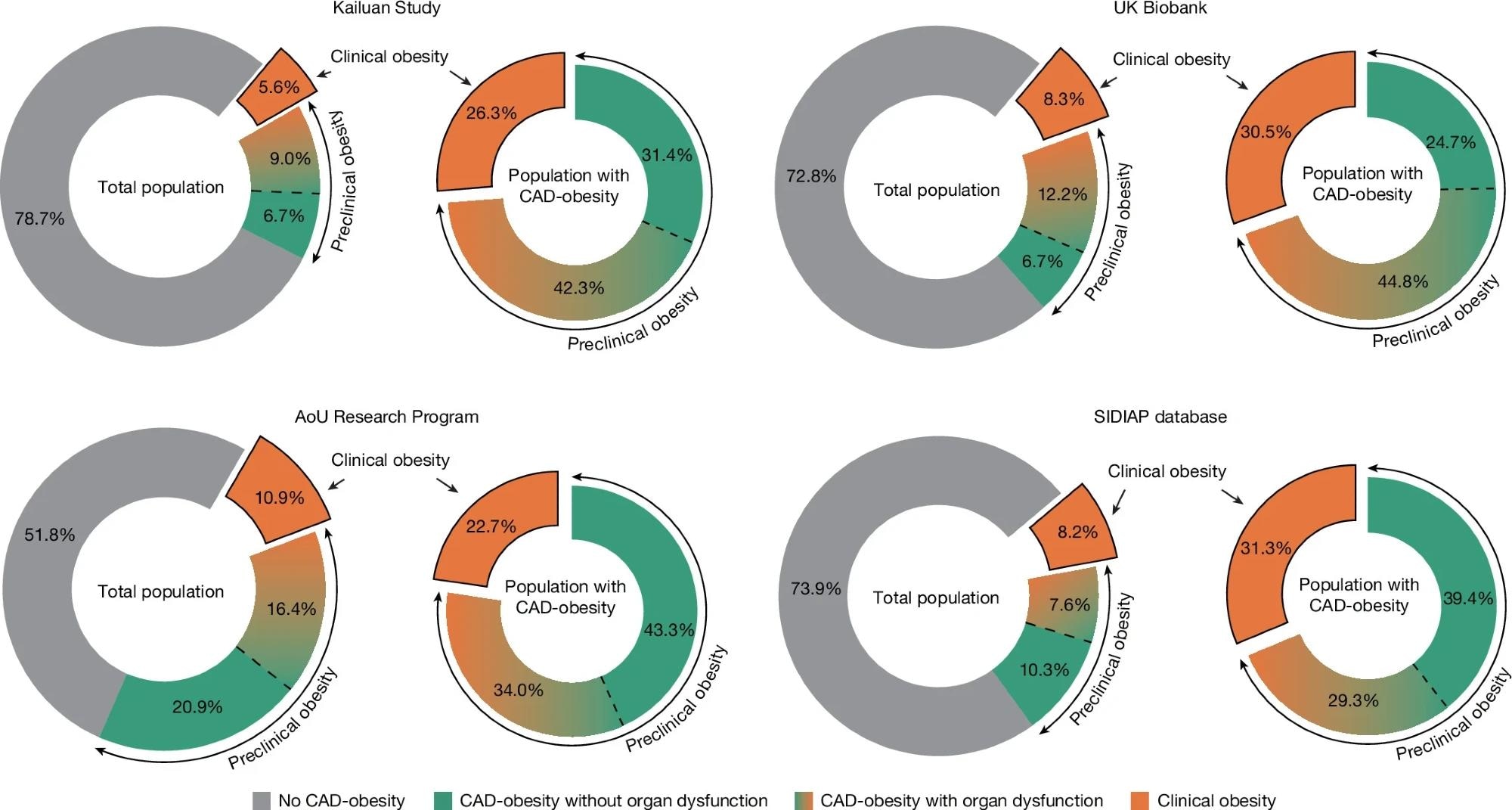
The analyses included 137,795 individuals from the Kailuan Examine, 436,203 individuals from the UK Biobank, 218,841 individuals from the All of Us Analysis Program and 51,269 individuals from the SIDIAP database. Gray segments characterize people with out CAD-obesity. Orange segments characterize the estimated AF-adjusted prevalence element of scientific weight problems, comparable to CAD-obesity with organ dysfunction statistically attributable to CAD-obesity on the inhabitants degree. Inexperienced segments characterize people with CAD-obesity however with out proof of organ dysfunction. Segments with a colour gradient characterize the estimated non-attributable prevalence element amongst individuals with CAD-obesity and organ dysfunction after utility of the AF adjustment. Collectively, the inexperienced and gradient segments characterize the estimated AF-adjusted prevalence of preclinical weight problems.
Mortality analyses revealed essential variations between typical BMI-based classification and CAD-obesity. BMI-defined chubby and weight problems with out CAD-obesity weren’t related to elevated all-cause mortality. Their mortality hazards had been barely decrease than these of individuals with out chubby or weight problems. Conversely, individuals assembly CAD-obesity standards had modestly elevated mortality hazards, no matter whether or not their BMI fell throughout the chubby or weight problems vary.
The strongest affiliation with mortality was noticed in scientific weight problems, which was linked to a 69% larger all-cause mortality hazard than in folks with out CAD-obesity or organ dysfunction. Preclinical weight problems was related to a 19% larger all-cause mortality hazard. Folks with organ dysfunction however with out CAD-obesity additionally had elevated mortality. The affiliation of scientific weight problems with mortality was stronger in ladies and people youthful than 60 years. The AoU cohort was excluded from mortality analyses as a result of follow-up was too quick.
Additional analyses indicated that utilizing a common WHtR threshold of 0.50 would considerably improve the variety of folks assembly the anthropometric criterion for weight problems. These recognized solely by this decrease threshold didn’t have elevated mortality threat, whereas larger ethnicity-specific thresholds supplied extra significant threat stratification. Further analyses produced constant findings.
Conclusions
The findings assist distinguishing scientific weight problems from preclinical weight problems and incorporating a number of anthropometric measures into weight problems prognosis. BMI alone could miss folks with elevated mortality threat and classify others as overweight who don’t meet the mixed standards. Scientific weight problems was related to considerably larger mortality, whereas most individuals with preclinical weight problems weren’t estimated to progress to scientific weight problems throughout follow-up. These variations assist care primarily based on particular person threat, with preventive therapy for preclinical weight problems and extra intensive administration when obesity-related organ dysfunction is established. Preclinical weight problems shouldn’t routinely exclude lively therapy, together with remedy or surgical procedure when clinically applicable.
The retrospective design, reliance on well being data, variations in accessible organ dysfunction indicators and evaluation frequency, and limitations in individual-level attribution name for potential research utilizing clinically validated diagnoses throughout various populations.
Supply:
Journal reference: