



From fasting to bedtime dietary supplements, researchers look at how ketones work together with deep sleep, REM cycles, and the physique’s inner clock.
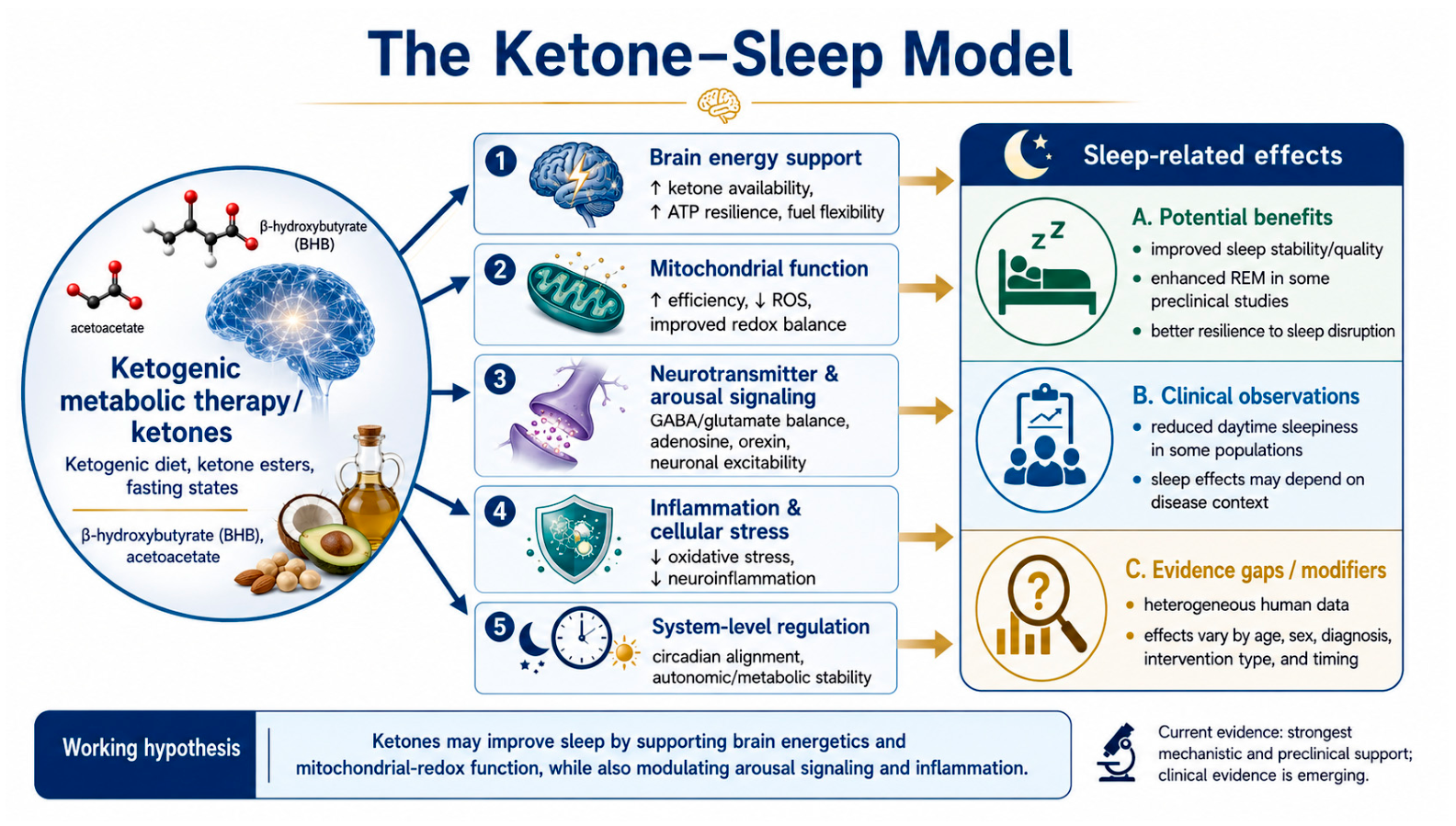
Working mannequin for ketone–sleep interactions. The determine summarizes the proposed mannequin through which ketone our bodies affect sleep by partially overlapping results on substrate availability, neuronal excitability, inflammatory tone, redox biology, epigenetic regulation, circadian timing, and respiratory/metabolic physiology. The determine was created with help from ChatGPT-5.6 (OpenAI). The authors reviewed and verified all scientific content material and labels. Assessment: Ketones and Sleep: A Narrative Assessment of Mechanisms, Preclinical Fashions, and Human Proof
A current overview printed within the journal Vitamins means that ketones could affect sleep, however responses fluctuate with food regimen, age, intercourse, metabolic well being, and circadian timing. The authors examined ketones as each power sources and signaling molecules. The findings could assist make clear whether or not dietary methods or ketone-based interventions might assist folks with sleep difficulties.
Sleep and metabolism are carefully linked, and ketones could play a job in that connection. Acetoacetate (AcAc), acetone, and β-hydroxybutyrate (BHB) ranges improve throughout fasting, carbohydrate restriction, extended train, or a ketogenic food regimen. Insulin deficiency may increase ketone ranges and, when extreme, trigger ketoacidosis, a harmful situation distinct from dietary ketosis. How these modifications have an effect on sleep high quality and the time spent in numerous sleep phases stays unclear.
In regards to the overview
Within the current narrative overview, the researchers examined animal, human, and mechanistic research on ketones and sleep, utilizing PubMed searches by September 2026. The proof lined fasting, calorie restriction, ketogenic diets, and ketone dietary supplements, prioritizing goal sleep and respiration measures. ClinicalTrials.gov and reference lists offered extra research. The preliminary PubMed search recognized roughly 329 data, whereas the ultimate overview cited 89 peer-reviewed publications and two clinical-trial registrations. The authors didn’t conduct a meta-analysis.
Preclinical and human proof linking ketones and sleep
Animal research present that sleep responses to ketones fluctuate by sort, food regimen, age, and intercourse. In mice, AcAc administered instantly into the mind elevated EEG slow-wave exercise throughout non-rapid eye motion (NREM) sleep, an impact not seen with BHB. AcAc additionally decreased glutamate launch. Ketogenic diets altered speedy eye motion (REM) and NREM sleep in rodents. In aged rats, ketogenic interventions elevated REM sleep in females, whereas a ketone ester decreased REM sleep in males; a ketogenic food regimen improved memory-related efficiency in each sexes.
In some wholesome adults, brief intervals of fasting or carbohydrate restriction have been linked to extra deep sleep and fewer REM sleep. Modifications in particular person sleep phases don’t essentially point out higher total sleep. For folks with epilepsy, a ketogenic food regimen has been related to shifts in sleep patterns, fewer seizure-related electrical discharges at evening, and improved high quality of life. Research in a number of sclerosis, migraine, and metabolic issues report improved subjective sleep, however broader scientific and metabolic modifications could contribute. Amongst skilled male cyclists, taking ketone esters after train and earlier than mattress was linked to greater sleep effectivity, preservation of REM sleep, and fewer time awake after sleep onset following an intense night exercise. Repeated D-BHB supplementation additionally improved chosen subjective sleep measures, however advantages have diverse throughout research.
Sleep and ketone metabolism could affect one another, however responses to ketogenic interventions fluctuate. Some folks expertise sleep disturbances throughout early dietary adaptation, whereas others report no change throughout sustained ketosis. The authors additionally suggest that improved daytime perform, seizure management, or restoration from train could not directly enhance subsequent sleep. Variations in examine design, food regimen, and sleep evaluation make comparisons troublesome, and it stays unclear whether or not ketones themselves drive these results or different metabolic modifications. Bigger managed trials utilizing goal sleep measures are wanted to establish who may profit.
The just lately accomplished Johns Hopkins Ok-SLEEP trial examined pre-sleep ketone supplementation utilizing goal sleep and metabolic measurements. The continuing STAK-Sleep + Feed trial compares a ketogenic food regimen, a blended food regimen with placebo, and a blended food regimen with ketone ester supplementation throughout sleep restriction. Within the associated STAK-Sleep trial, a ketogenic precursor elevated wearable-measured deep sleep and improved chosen waking-performance measures below restricted sleep situations, however EEG affirmation of sleep-stage modifications is required. These diverse outcomes have drawn consideration to potential pathways linking ketones with sleep regulation.
Mechanistic hyperlinks between ketone our bodies and sleep
Past supplying power, ketones could have an effect on nerve cell exercise, irritation, oxidative stress, and gene expression. For instance, acetoacetate (AcAc) could scale back excitatory signaling by limiting glutamate launch. Ketogenic metabolism may have an effect on ATP-sensitive potassium (KATP) channels and adenosine signaling, each of which may dampen nerve cell exercise. The relevance of those processes to sleep could differ with age, metabolic well being, sleep loss, and restoration after train.
BHB may affect inflammatory and epigenetic pathways. Experimental research counsel that it may well suppress the NLRP3 inflammasome, a protein advanced concerned in irritation. BHB may have an effect on histone deacetylases and a chemical modification referred to as histone β-hydroxybutyrylation, each concerned in regulating gene exercise. Such modifications might assist cells handle oxidative stress, adapt to physiological calls for, and alter gene expression by pathways probably related to sleep and neural restoration. The importance of those pathways for human sleep stays unsure.
Circadian rhythms add one other layer to this relationship. Mouse research counsel that circadian clocks assist management when ketones are produced, partly by pathways involving peroxisome proliferator-activated receptor alpha (PPARα). Ketogenic diets may alter each day gene exercise in peripheral tissues. Fasting and time-restricted consuming have an effect on ketone ranges, glucose, insulin, and appetite-related hormones, so the contribution of ketones alone is tough to find out.
Modifications in sleep may come up from weight reduction, improved respiration, or higher seizure management throughout ketogenic remedy. In a examine of sufferers with weight problems hypoventilation syndrome, a ketogenic food regimen improved nocturnal respiration, however results on sleep phases weren’t established. The train findings level to a potential position for previous physiological stress, whereas a separate examine discovered that ketone esters didn’t reverse hypoxia-related disruption of sleep structure. The consequences seem to fluctuate with the individual’s metabolic state and the circumstances through which ketones are used.
Conclusion
The findings counsel that ketones could have an effect on sleep phases and continuity, however responses could differ with an individual’s metabolic well being, age, intercourse, physique clock, and degree of physiological stress. Bigger, well-controlled research might assist decide whether or not specific doses enhance sleep and establish individuals who would profit most. Researchers have but to establish an optimum ketone focus or dosing schedule for sleep, and present proof doesn’t help ketogenic interventions as established remedies for insomnia. Future research ought to measure nocturnal AcAc and BHB alongside goal sleep, respiratory, and next-day cognitive outcomes to tell apart direct results on sleep regulation from these linked to broader metabolic modifications.
Supply:
Journal reference: